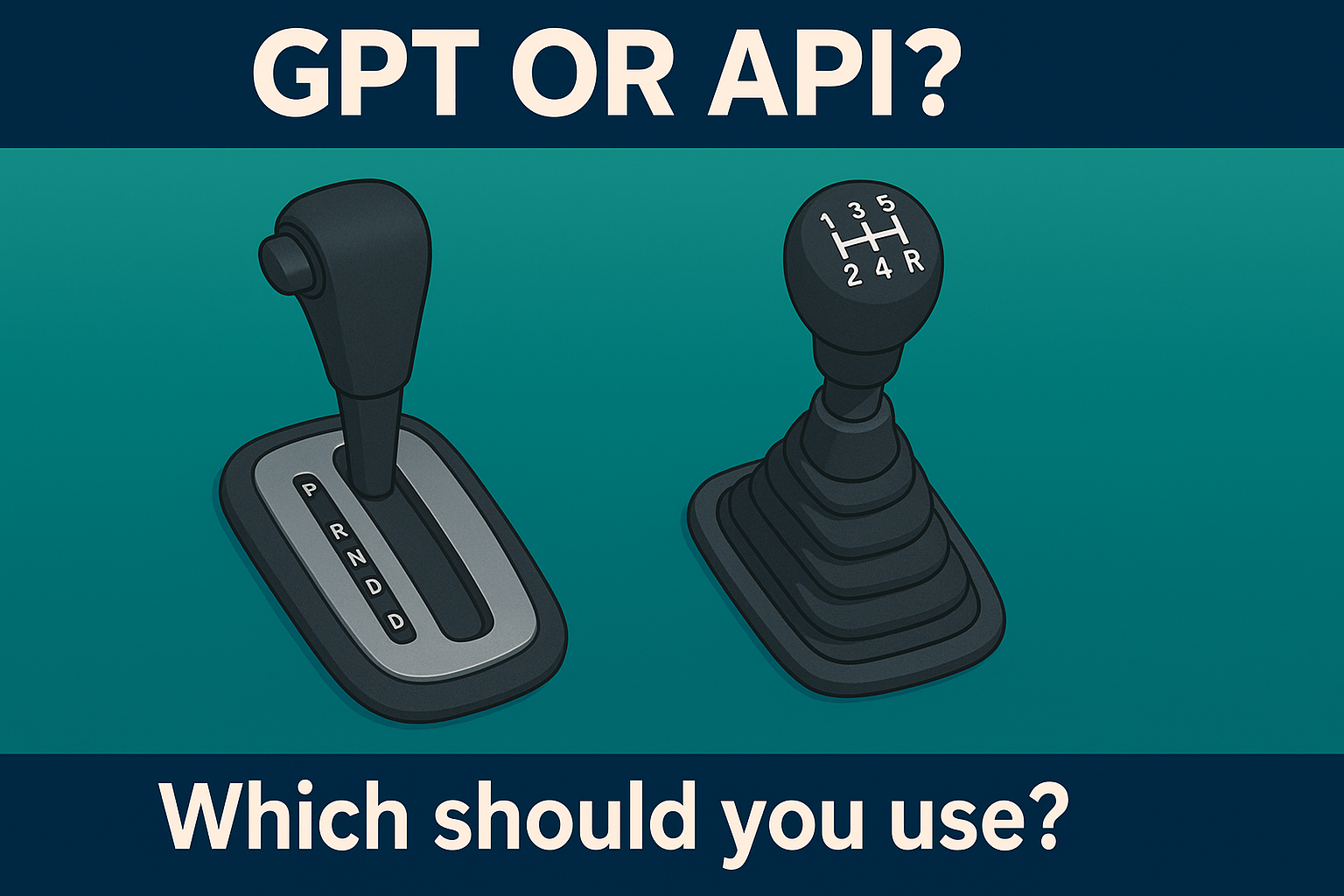
Here is a question - when is it better to use a GPT or the API?
OpenAI provides two methods of creating an AI "application." For prototyping and basic applications, OpenAI adoption managers will suggest the use of "GPT's." ChatGPT explains that a GPT is "a customized version of ChatGPT that combines specific instructions, knowledge, and tools to create a tailored AI application for a particular purpose or domain." If you have a basic application, this is a great way to get started.
A more advanced method of creating an application is to use the ChatGPT API's. There are a few different API's, based on purpose. The API provides greater flexibility at the cost that building an application is more complex. For example, as of October 2025, with GPT's only Enterprise and Business accounts can access user analytics in aggregated form. If you need detailed information for debugging or compliance, you need to build your application with an API.
Another significant difference: Currently, GPT's are free, while using an API may require purchasing tokens. There might be benefit to dealing with costs now, as it prepares you for the future.
There is an easy migration path from a GPT to an API-enabled application.
Here is an example of an application built as a GPT and as a web app using an API. In this demo, we see ChatGPT's ability to research, aggregate loosely structured data, and transform the data to a new domain. It is kind of fun - you ask about a singer or a band, and ChatGPT will summarize their musical career and transform it into an astronomical equivalent. While this application is a game, one can imagine multiple applications of this approach, such as transforming applicant resumes into an assessment of technical skills. Both examples use the same instruction and taxonomy, demonstrating migration from GPT to API.
GPT version: https://chatgpt.com/g/g-68ad2c929eec81919104b9f3947d085a-the-orbital-mechanics-of-musical-careers
Web application using API: https://hexteal.ai/index.php/article-list/just-the-demo