
Home
GPT or API?
- Details
- Written by: Sean Noble
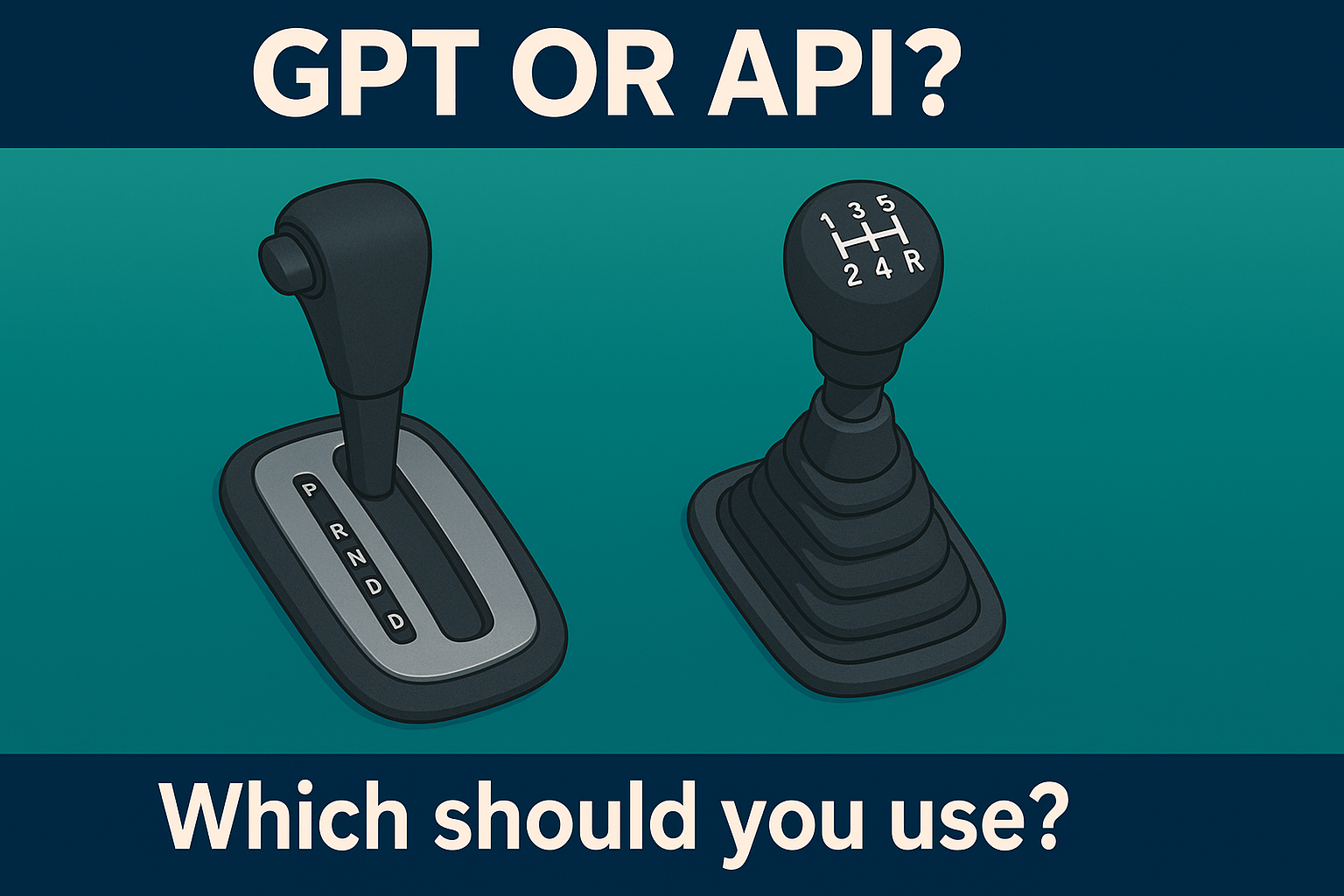
Here is a question - when is it better to use a GPT or the API?
OpenAI provides two methods of creating an AI "application." For prototyping and basic applications, OpenAI adoption managers will suggest the use of "GPT's." ChatGPT explains that a GPT is "a customized version of ChatGPT that combines specific instructions, knowledge, and tools to create a tailored AI application for a particular purpose or domain." If you have a basic application, this is a great way to get started.
A more advanced method of creating an application is to use the ChatGPT API's. There are a few different API's, based on purpose. The API provides greater flexibility at the cost that building an application is more complex. For example, as of October 2025, with GPT's only Enterprise and Business accounts can access user analytics in aggregated form. If you need detailed information for debugging or compliance, you need to build your application with an API.
Another significant difference: Currently, GPT's are free, while using an API may require purchasing tokens. There might be benefit to dealing with costs now, as it prepares you for the future.
There is an easy migration path from a GPT to an API-enabled application.
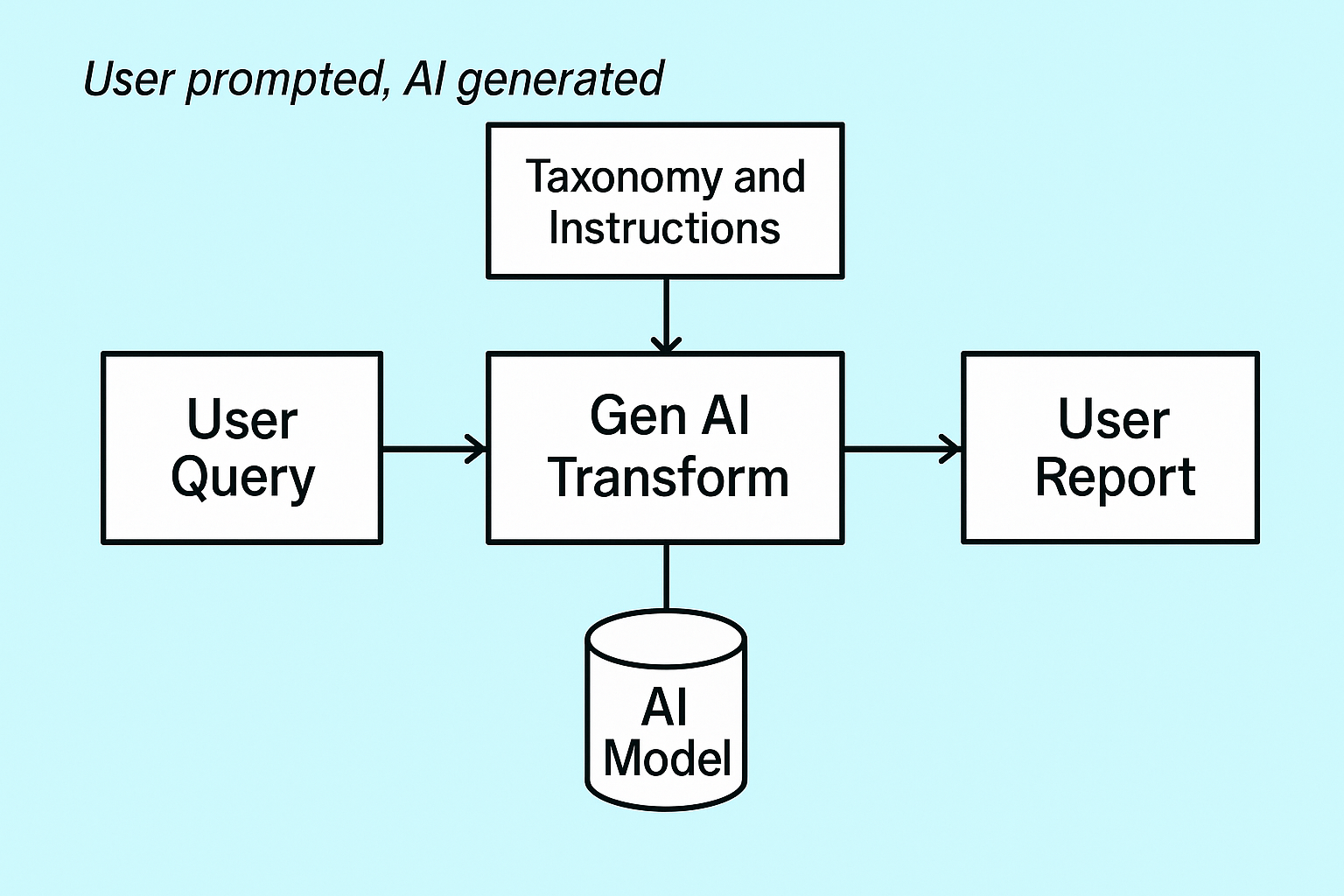
Here is an example of an application built as a GPT and as a web app using an API. In this demo, we see ChatGPT's ability to research, aggregate loosely structured data, and transform the data to a new domain. It is kind of fun - you ask about a singer or a band, and ChatGPT will summarize their musical career and transform it into an astronomical equivalent. While this application is a game, one can imagine multiple applications of this approach, such as transforming applicant resumes into an assessment of technical skills. Both examples use the same instruction and taxonomy, demonstrating migration from GPT to API.
GPT version: https://chatgpt.com/g/g-68ad2c929eec81919104b9f3947d085a-the-orbital-mechanics-of-musical-careers
Web application using API: https://hexteal.ai/index.php/article-list/just-the-demo
GenAI as Software Consultants
- Details
- Written by: Sean Noble
I am starting a series of posts on lessons learned using GenAI for code development. I welcome you comments and rebuttals. The overarching message is that GenAI must be managed like a consultant who was brought in to augment a software development team. The consultant must be constantly measured for effectiveness. As consultants can be temporary, a concerted effort must be pursued to ensure that their code can be maintained if they leave or are replaced with a new consultant.
If I were a professor or educator, I would strongly consider adding this to my AI curriculum, as I think this will make college hires attractive to employers. The entry-level software developer and computer engineer must be able to design and develop with AI as their teammate. Essentially, they enter the workforce with the same impact and productivity as today's mid-career employee.
I think you will find that if you use this construct, you can apply lessons learned from existing business-to-consultant best practices apply with GenAI as well. For example, as today's consultant may work for a competitor tomorrow, a best practice is to limit sensitive knowledge provided to the consultant. By protecting "the crown jewels," you limit the potential for leaks and data loss. While the GenAI service, whether it be ChatGPT, Claude, Gemini, or Grok, may already have guardrails in place, you can never be certain that there are not bugs, leaks, or discovery disclosures. You want to rely on your guardrails, not the consultants.
Another best practice - consultants seek to maintain current business or attract new business. It is well-noted that GenAI can be near sycophantic. You should always take GenAI's commentary with a grain of salt, especially if the comment could be a hallucination. If GenAI tells you, "That is a unique product idea," ask it to verify before you patent or protect the idea. I have found that if you follow with a deep research verification, sometimes it is unique, other times not.
Another consideration - what aspect of the software do you want to be solely your own, so that you have "clear title?" I wrote and reviewed this without AI as I want these words to be my own, grammar mistakes and all.
Six Neurons to Bacon(TM)
- Details
- Written by: Sean Noble
Did you know that you can create games with LLM's? I used ChatGPT to build a game like Six Degrees to Kevin Bacon, with a twist: The player provides hints, not an actor name.
Gaming is big business. Globally, gaming industry sales exceed combined film and music sales. AI allows us to quickly develop games that are loosely structured with high ambiguity. Check out this variation of Six Degrees to Kevin Bacon. Instead of asking the LLM to connect an actor to Kevin Bacon, the player gives clues. The LLM must use the clues to guess the actor, then connect them to Kevin Bacon. Given the ambiguity, you might find the LLM even fixes bad clues.
Here are some sample hints/prompts:
- she was a cheerleader in two movies, and also spoke Albanian.
- ok, she was a slayer and a Scooby Doo groupie
- this bald man would say, "i'm tryin' to think but nutthin happens"
- this actor, who played a purser in a 70's/80's show about a boat. later in real life, he represented Iowa in Congress.
- he played an ex-Army major who roams the country helping law enforcement in Netflix series. Unlike the movie version, this actor is muscular for the part.
For instructions, type "INSTRUCT" and click "Send." Then prompt away! Wait 20 seconds after you click send. It takes time to get a reply, especially with obscure actors.
If the game is unavailable, please check later as I update billing.
[This article's text was generated without AI. Graphics were AI generated.]
(c) 2025 Sean Noble
2.0 Just the Demo
- Details
- Written by: Sean Noble
This article is focused solely on the demo.
ChatGPT has fascinating capabilities that you might not expect, like processing loosely structured, sequential data from one domain - such as musical history - and transforming it into another domain - such as space objects and maneuvers. The demo may seem nerdy and inconsequential, but demonstrates some powerful features of ChatGPT. First, the desired user input is the name of a musician or a band. But it can be indirect and vague. It does not even need to be in English!
After the user click "Send", ChatGPT identifies the subject and assembles their musical history. It the uses internal instructions and taxonomy, hidden from the user, to transform the musical history into a celestial narrative. This is a hard problem when you consider the loose structure and the value calls that must be made to distinguish between a musical career that does not achieve escape velocity (ie, it never gets off the ground), a career that is a supernova, or a career that collapses like a black hole.
Wait 20 seconds after you click send. It takes time to get started. If it does not answer, please try again after credits have been updated.
[This article's text was generated without AI. Graphics were AI generated.]
(c) 2025 Sean Noble